someipy v2: What’s New
This page outlines the new features and changes introduced in version 2 of the someipy Python package. Version 2 introduces a new architecture and a refined application API, addressing limitations present in version 1.0.
New Architecture
someipy v2 features a redesigned architecture that eliminates key weaknesses of the previous version. In v1, each application utilizing someipy required its own network interface. Version 2 centralizes network interface handling within a dedicated someipyd daemon.
someipyd Daemon: A new someipyd.py daemon is introduced to manage all communication, including:
SOME/IP service discovery via UDP multicast and unicast.
SOME/IP message exchange (methods, events, fields).
Unix Domain Socket Communication: Applications using someipy communicate with the someipyd daemon via Unix Domain Sockets, eliminating the need for direct network access.
Centralized Network Handling: The someipyd daemon handles all network communication, allowing applications to remain lightweight and focused on application logic.
Scalability: Each ECU or PC can run a single someipyd daemon, supporting an arbitrary number of applications.
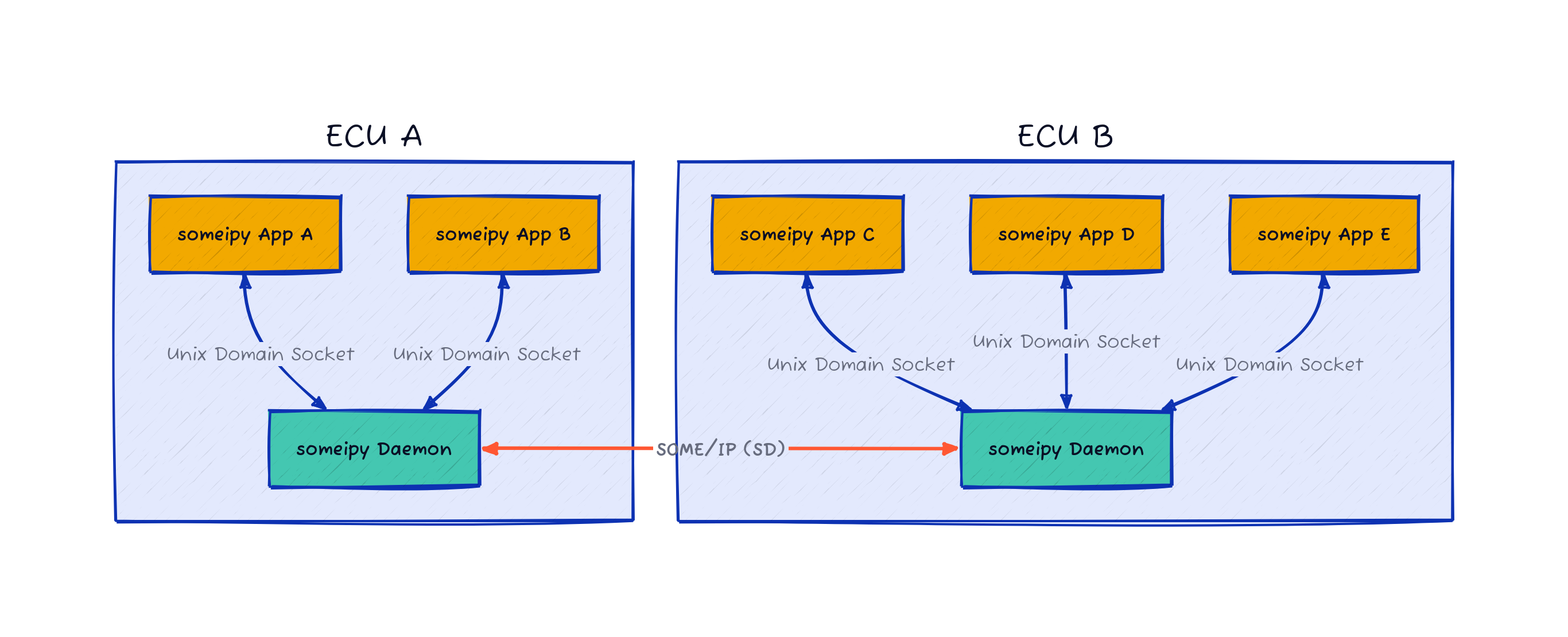
The diagram above illustrates the new architecture, showcasing the central role of the someipyd daemon in managing all SOME/IP communication.
New Application API
The application API has been streamlined for ease of use and flexibility. The following snippets demonstrate the core elements of the new API:
someipy_daemon = await connect_to_someipy_daemon()
Establish a connection to the someipyd daemon.
addition_method = Method(
    id=SAMPLE_METHOD_ID,
    protocol=TransportLayerProtocol.UDP,
)
addition_service = (
    ServiceBuilder()
    .with_service_id(SAMPLE_SERVICE_ID)
    .with_major_version(1)
    .with_method(addition_method)
    .build()
)
Define a service with its methods, eventgroups, and events.
client_instance_addition = ClientServiceInstance(
    daemon=someipy_daemon,
    service=addition_service,
    instance_id=SAMPLE_INSTANCE_ID,
    endpoint_ip=interface_ip,
    endpoint_port=3002,
)
Construct a ClientServiceInstance for service interaction.
method_parameter = Addends(addend1=1, addend2=2)
method_result = await client_instance_addition.call_method(
    SAMPLE_METHOD_ID, method_parameter.serialize()
)

sum = Sum().deserialize(method_result.payload)
print(f"Sum: {sum.value.value}")
Prepare method parameters, call the method, and deserialize the result.
await someipy_daemon.disconnect_from_daemon()
Disconnect from the daemon.